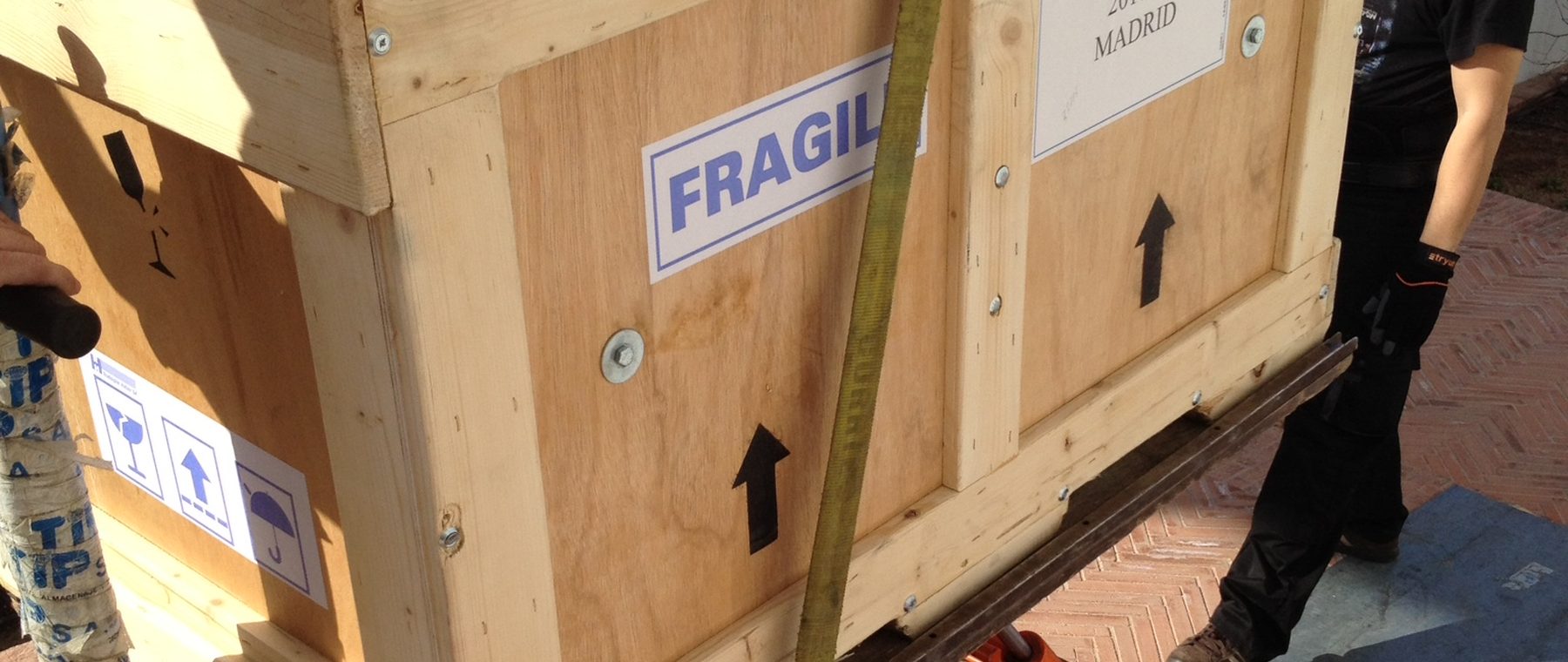
Art is everywhere and at every stage of our lives. Whether it adorns houses, or appears in exhibitions, museums or public places, among many other settings. The need to have art around us obliges us to move it from one place to another. Whether because we are moving house, because we have just bought a work of art, in order to put on an exhibition, or for whatever other reason, moving art is very common. That creates a problem, because moving art is not like moving anything else. Moving art involves a series of rules and an almost extreme degree of care that must be taken with the works in order to protect them.
01 How art is transported
To move a work, the first step is to pack it. That process must be extremely careful; it takes several stages and special materials such as acid-free paper and bubble wrap. Once packed, the works go into a crate built for the purpose. These wooden crates are always made to measure and sealed airtight so that no unwanted particle can get in. They normally also have ways of cushioning knocks, and specific treatments for each case. In sea transport, for instance, moisture barriers are included.
02 Road transport
This method of transport is the most used — not to say the one that is always used, since even if the work is going to travel by air it always has to be taken to the airport. To move a work by road, specialised trucks are always used, fitted with various improvements for the purpose. One of these trucks must have temperature regulators and fire alarms, for example. It must also have air suspension to absorb whatever the road throws up, and securing systems so the work cannot move. Where works are of great financial value, armoured trucks are also used, normally under escort.
03 Air transport
When the destination is too far away, the option almost always chosen is air transport. In this case the aircraft is prepared to carry the work to specifications very similar to those of the truck. Those measures are temperature regulation and fire precautions. Securing systems must also be used on the aircraft so that the work stays intact through any turbulence.
04 Sea transport
When it comes to works of art of great size, or to a large collection, sea transport is usually the best option. Here the holds in which the art will travel must be equally well prepared. But extra measures have to be taken when loading and unloading. All of this is only a little of the background to moving works of art, and of how complicated it can turn out to be. Even so, if you have works of art to move, do not worry: at World Pack-Art & Services we have high-quality staff, years of experience and the right equipment for the task. Whether by road, sea or air, your works of art will be in good hands. Contact WPAS and stop worrying about how your works will arrive.